 Zapraszamy do sklepu http://www.example.com |
Pełna nazwa firmy ullica nr kod Miasto tel. +48 00 0000-000 |
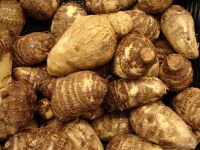
Fresh Arbi Taro Root Coco Yam 250g
Little India > Fresh Vegetables & Fruits

Price gros: 9.00 zł
Price net: 8.57 zł
The product belongs to our fresh assortment of exotic vegetables, selected with South Asian, Southeast Asian, and other world cuisines in mind. Fresh vegetables are imported depending on the season and availability, so the country of origin, size, shape, skin shade, and other natural characteristics may vary between individual deliveries. For fresh products, the most important information regarding the country of origin and specific batch is provided according to the current delivery labeling. Natural differences in appearance, size, and ripeness are typical features of fresh vegetables and do not indicate a product defect.
Edible colocasia, known as Arbi, Taro Root, Taro, Colocasia, or Coco Yam, is a tropical tuberous vegetable belonging to the species Colocasia esculenta, widely used in the cuisines of Asia, Africa, the Caribbean, and Pacific islands. In India, the name arbi is particularly popular, and regional terms such as arvi and colocasia are also encountered. The edible underground part of the plant usually has a brown, rough skin and light flesh, the appearance of which may vary depending on the variety and batch. After proper heat treatment, the flesh becomes soft, creamy, and starchy, making taro useful in many ways similar to potatoes, although it has its own distinctive flavor profile. In Indian cuisine, arbi is used to prepare curry, sabzi, and fried dishes. Popular dishes include arbi masala, sukhi arbi, and various regional recipes in which cooked pieces of colocasia are then sautéed with cumin, coriander, turmeric, chili, amchur, and other spices. Taro can be boiled, stewed, baked, or fried after prior preparation. It pairs well with onion, tomatoes, garlic, ginger, chili, cumin, coriander, and masala blends. It can be served as a vegetable side dish with rice, dal, roti, chapati, and other South Asian cuisine dishes. Taro is also an important ingredient in many cuisines outside India, where it is used in soups, stews, braised dishes, and other recipes based on starchy vegetables. However, colocasia requires proper processing before consumption. Raw taro contains naturally occurring calcium oxalate crystals, which can cause severe irritation of the mouth, throat, and digestive tract, so the product should not be eaten raw. The tubers must be thoroughly cooked or subjected to other appropriate heat treatment until fully softened. When peeling raw taro, some people may experience skin irritation, so gloves are recommended for those with greater sensitivity. The term Coco Yam or Cocoyam is sometimes used in trade to refer to several similar tuberous plants, so for precise botanical identification of a specific batch, its labeling should be followed. Due to the natural nature of the product, individual tubers may vary in size, shape, skin color, surface texture, and flesh appearance.
Update + Piotr 25.09.2026
Product options
Dodatkowe informacje:
| Packaging condition: | original |
| Trade name: | Arbi Taro Root Coco Yam |
| Product does not contain: | not applicable |
| Additional features: | lack |
| Weight (g): | 250 |
 Polski
 Czeska
 Deutsch
 Hiszpańska
 Rosyjska